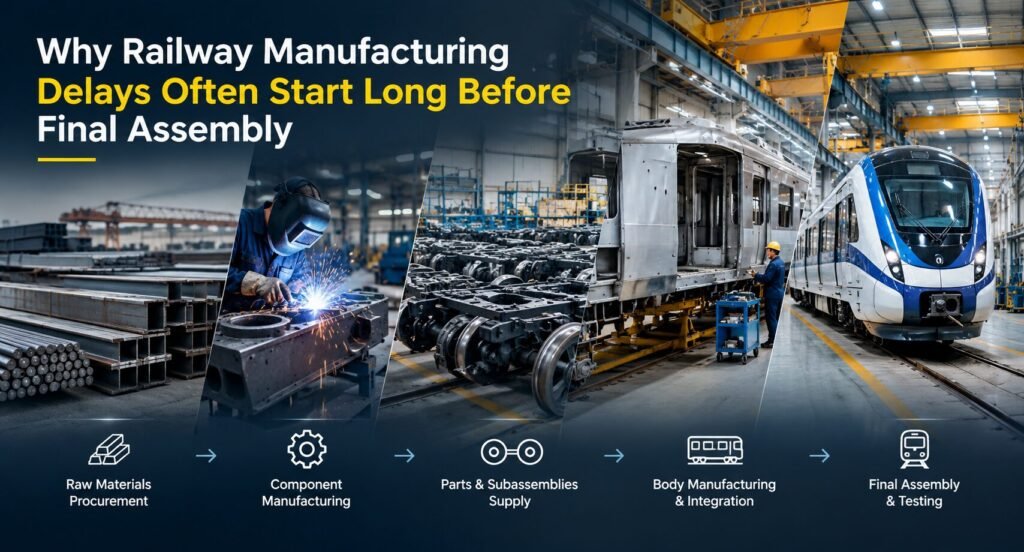
A railway assembly line can slow down even when most of the required parts appear to be ready.
One sub-assembly may still be under inspection, another may need dimensional correction, or a matching component may arrive later than the rest of the batch.
The disruption becomes visible when everything has to come together, although the lost time may have entered the schedule several stages earlier.
Tracing the delay backwards usually gives you a much clearer picture of where production first started losing time.
Final assembly often exposes work that was already incomplete
Final assembly depends on several railway components reaching the same point in a usable and approved condition, which means one unfinished input can hold back work that is otherwise ready to proceed.
A body arrangement may still need clearance, a casting may require correction, or a fabricated component may be waiting for the matching item that completes the assembly.
The problem becomes more expensive at this stage because people, fixtures, equipment, and other components have already been scheduled around the planned assembly window.
Your assembly date therefore depends on more than physical availability, since every required component also needs to arrive with its manufacturing, inspection, and documentation work complete.
Inspection can reveal delays created several operations earlier
Inspection often exposes variation that entered railway component manufacturing during forming, casting, machining, welding, handling, or an earlier material-control stage.
A dimensional issue found after several operations may send the component back for correction, while incomplete traceability can hold a finished part until its material or batch records are resolved.
Earlier checks give your production team more room to contain such issues within the operation where they first appear.
Once extra processing has already been added, even a small correction can affect another fixture slot, inspection window, or planned delivery to the next production stage.
Material and supplier readiness shape when production can actually start
Material and supplier readiness influence railway manufacturing schedules before work reaches the shop floor, especially when several components follow different production cycles.
A few practical checks can reveal where a planned start date still carries uncertainty:
- The required material grades, sizes, and quantities need to be available for the planned production batch.
- Matching railway wagon components need schedules that bring them together within the same assembly window.
- Critical processes need enough available capacity to support the required sequence as well as the expected delivery date.
- Alternative sourcing options can provide greater flexibility when one material or component carries a large share of the schedule dependency.
A production date becomes much more useful once these conditions support it in practice.
Drawing and approval changes can consume time before the first batch settles
Engineering changes can affect material orders, tooling, process planning, prototypes, inspection criteria, and supplier instructions before regular production develops a stable rhythm.
A revised interface dimension may alter a cold rolled formed section, railway casting, hole position, welded connection, or adjoining component, which then carries the change into several later activities.
Prototype feedback and approval requirements can create similar effects when they lead to revisions after manufacturing preparation has already started.
A more mature engineering package gives purchasing, production, suppliers, inspection teams, and assembly teams the same technical basis, which reduces the amount of upstream change reaching an active production schedule.
Final Thoughts
Railway manufacturing delays become easier to understand when you trace the schedule backwards from the point where work finally stopped, because final assembly often reveals a dependency that had been developing for much longer.
The first loss of time may sit in engineering, material readiness, component manufacturing, inspection, or the timing between connected suppliers.
Across Cosmic Birla Group, our railway-facing businesses work with cold rolled formed sections, wagon construction components, railway castings, and other specialised railway parts, giving us exposure to several stages that feed into the wider manufacturing chain.
Looking at those stages as connected production dependencies can help teams spot schedule pressure earlier, when there is still more room to address it before final assembly feels the effect.