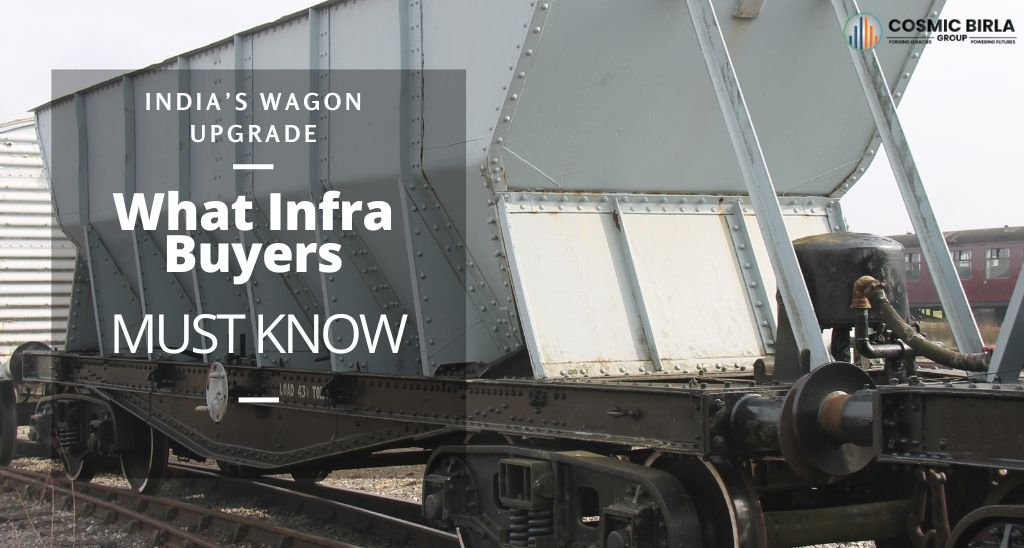
Wagon modernization no longer sits in the future tense. It is already happening across depots, corridors, and procurement cycles.
More tonnage, faster speeds, and revised axle norms have pushed the conversation beyond capacity.
Now, teams must rethink what goes into the wagon itself.
If you handle procurement or work on the planning side, you’ve likely seen the specs evolve. Lighter materials. Modular builds. Tighter tolerances.
But with each upgrade, the margin for error gets thinner. That changes how you evaluate not just the wagon, but every part that goes into it.
Here are the newer questions buyers need to ask as wagon modernization gains momentum.
Material Behavior Matters More Than Material Grade
A steel grade alone does not tell you how a profile will behave during fit-up or over time.
Two vendors might offer the same grade on paper, but the forming route, rolling technique, and coil source can change everything, from weldability to final fit.
For modern wagons, where weight targets are strict and geometries tighter, the material needs to behave predictably across batches. This impacts how frames align, how holes stay true, and how joints respond under repeated load.
Procurement must look beyond mill test certificates and consider how the material will actually perform in the production and assembly context.
Weight Reduction Creates New Pressure on Precision
As designs move toward lighter builds, smaller deviations matter more.
Earlier, a small overbend or misalignment might have been absorbed by thicker steel or larger joint brackets.
In newer wagons, those same deviations could result in a part not fitting, or worse, introduce unseen stress that shortens the service life.
Infra buyers must now assess whether vendors can deliver not just the right shape, but the right shape consistently. Repeatability is no longer a bonus; it’s a requirement. This raises the bar on tooling, forming process control, and in-line checks.
Suppliers who treat forming as a system (not a series of manual corrections) tend to offer more stable results over time.
Joint Behavior Has to Be Engineered, Not Assumed
Wagon bodies involve a mix of welded, bolted, and slotted joints. Each one plays a different role under torsion, bending, or vibration.
In legacy builds, many joints were overbuilt for safety. But with modernization, the engineering has tightened and that includes joint performance.
For buyers, this means tracking how the profile geometry supports or complicates those joints.
Does the profile require extensive post-fabrication welding? Are the slots clean and stress-relieved? Do ribs or bends help distribute stress, or do they concentrate it?
These details affect not just performance, but also how fast a wagon clears QA in the first place.
Smoother Assembly Lowers Lifetime Cost
Assembly speed used to be a production issue. Now it affects total cost of ownership. Why?
Because assembly errors ripple into inspection, maintenance, and warranty claims. A poorly nested profile or a slight misalignment can delay one handover or cost weeks when replicated across 200 wagons.
As wagons get more modular, smooth interface behavior between parts becomes critical. Infra buyers should ask vendors not only for per-part pricing but also evidence of assembly outcomes.
The best suppliers know where their parts sit in the full wagon ecosystem and produce with that context in mind.
Standardization Helps Only If the Standards Stay True
The push toward standardized railway components works only if those standards are followed with precision.
Inconsistent slot widths, unexpected burrs, or shifted profiles can defeat the very efficiencies modularity aims to create.
When buyers source from multiple suppliers, the challenge compounds.
What’s needed now is not just dimensional accuracy, but behavioral consistency. That includes surface finish, bend radii, and even packaging, so parts arrive ready to fit, not ready for adjustment.
Procurement teams that audit against real-world assembly fit, not just catalog dimensions, will see fewer delays and better wagon throughput.
Final Thoughts
Wagon modernization reshapes what procurement and planning teams must pay attention to. It narrows tolerance windows, increases the cost of inconsistencies, and raises the bar for every part that feeds into assembly.
At our end, the Cosmic Birla Group works with project planners, EPCs, and railway teams to align raw material behavior with real-world assembly outcomes.
Whether it’s cold-formed sections, standardized profiles, or rework-reducing geometry, we support you in making better decisions at the start; when they matter most.
If you want to learn about new wagon specs and need profiles that align with those demands, reach out to us. We’re here to help you build forward.