Two railway suppliers may quote similar prices and delivery dates while carrying very different levels of production risk.
The real difference often sits behind the quotation, in their experience with the exact component, usable capacity, inspection records, material dependencies, and response when plans change.
Procurement teams get a clearer picture when those claims are backed by evidence from actual production.
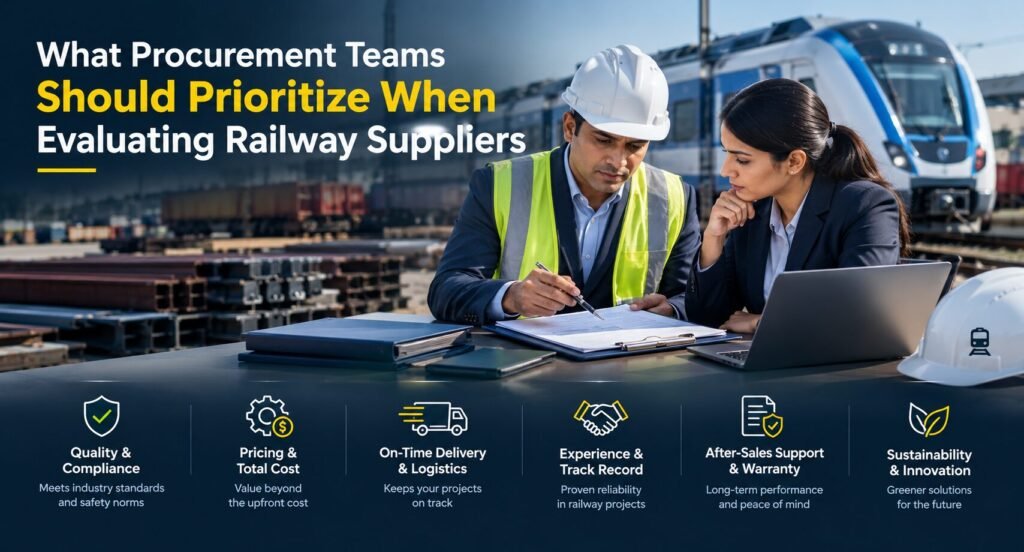
Here are five areas that can tell you far more about a railway supplier before you place them on your shortlist.
Check capability for the exact component you need
A supplier’s general railway experience carries more weight when it matches the component, process, and specification involved in your order.
Producing a cold rolled formed section requires a different combination of tooling, dimensional control, and process knowledge from manufacturing a railway casting, brake beam, or machined bogie component.
Your review can therefore look at past work with similar railway components, relevant tooling, testing arrangements, approved procedures, prototype experience, and any item-specific qualification required for the programme. This gives procurement a clearer view of whether the supplier has handled comparable manufacturing demands before.
Look beyond stated capacity to the production schedule
Available capacity is important when it exists in the same process and time window your order requires.
A railway components manufacturer may have substantial overall output while one forming line, machining centre, heat-treatment stage, welding fixture, or inspection station carries most of the load for your particular component.
It can help to understand current commitments, batch sizes, expected cycle times, and any operation that controls how quickly finished parts can move forward. These details put the promised lead time into a practical production context.
Look for quality records that tell a production story
A useful quality system leaves enough evidence to trace a component from incoming material through manufacturing and final release.
Material certificates, stage inspection records, calibration history, internal rejection data, batch identification, and finished-product checks can show how consistently the supplier controls its process.
The records also give procurement something concrete to review when variation appears across repeated deliveries.
For railway wagon parts and other safety-related components, this production history often tells you more than a certification logo or a quality statement in a supplier presentation.
Understand where the supplier depends on others
External dependencies can shape delivery performance even when the supplier’s own production remains well planned.
A few areas deserve a closer look during supplier discussions:
- Raw materials: Availability of the required grade, size, and approved source can influence when production begins.
- Outsourced processes: Machining, heat treatment, coating, testing, or other outside operations can add another schedule dependency.
- Single-source inputs: One critical material or sub-component coming from a single source can leave less room when supply conditions change.
- Alternative sources: Qualified secondary options can give the production plan more flexibility during longer railway programmes.
This view helps procurement understand how much of the quoted delivery schedule sits inside the supplier’s direct control.
See how the supplier handles change during the programme
A supplier’s operating discipline becomes easier to judge when a drawing, quantity, material source, or production condition changes after work has started.
You may want to understand how revisions reach the shop floor, how affected batches are separated, how recurring defects are recorded, and how schedule changes are communicated across purchasing, production, inspection, and dispatch.
Railway programmes can run across many batches, so the ability to keep technical changes controlled can matter as much as performance during the first delivery.
A clear change process also gives your team better visibility when the original production plan starts moving.
Final Thoughts
Strong railway supplier selection comes from understanding how the supplier actually produces, controls, and delivers the component you intend to buy.
Price and lead time still matter, but they become far more useful when viewed alongside item-specific capability, usable capacity, quality records, external dependencies, and the supplier’s response to change.
Our railway-facing businesses across Cosmic Birla Group work with cold rolled formed sections, wagon construction components, railway castings, and other specialised railway parts, which keeps us close to several different production requirements within the same sector. For procurement teams reviewing an upcoming railway requirement, comparing suppliers through these operating signals can make the eventual shortlist much easier to defend.